Managing Large Litters.
Breeding goals for sows have evolved over the past few decades. The focus has been on selecting for higher ovulation rates and larger litter sizes. The objective is to increase the number of piglets born per sow per year, thereby enhancing productivity and economic efficiency. However, these changes have also contributed to several problems, such as inhomogeneous litters, low birth weights, higher piglet mortality, increased treatment costs and the need for increased management, as well as reduced longevity of the sows. These changes present a true challenge for the sows, their piglets, and the farmers!
This newsletter explains why farm-individual (farm-specific) concepts are essential for today’s hyperprolific herds and why it is important to think of the sow and her piglets as one unit. We outline some strategies to align litter size with the sow’s biological capacity, and you will see how tailored programs improve piglet uniformity and survival, protect sow body condition and longevity, and reduce the need for interventions. The goal is simple: more healthy, resilient piglets weaned and a more sustainable, profitable sow herd.
Improved Productivity of Hyperprolific Sows. And Now?
In recent decades, genetic selection and management advances have dramatically increased the productivity of hyperprolific sows. Litter sizes have grown, farrowing rates have improved, and the number of live piglets born per sow per year continues to set records. However, this progress also presents new challenges for the industry. Large litters often result in greater birth weight variation, increased competition at the udder, and a greater risk of pre-weaning mortality. High morbidity and mortality rates among neonatal piglets have become a matter of growing concern in recent years.
Despite improved management practices, up to 20 % of piglets are still lost during farrowing or early lactation. Sows themselves face higher metabolic demands, raising concerns about body condition, longevity, and welfare. Although productivity per sow has improved, the focus is now shifting toward sustainability, robustness, and animal well-being. The key question is no longer simply “How many piglets can a sow produce?” but rather “How many healthy and uniform piglets can be successfully weaned while maintaining sow health?”
What are hyperprolific sows?
These sows produce more piglets than they have functional teats. Although modern sows typically have no more than 14–16 teats, litters of 18–20 piglets, or more, are becoming common. An increase in sow prolificacy can lead to considerable variation in birth weight and a decline in the survival rate of piglets during and after birth. Large litters result in prolonged parturition and increased risk of hypoxia and suffocation, especially for last-born piglets. This can result in increased stillbirths, higher mortality rates, decreased performance, and a lower number of weaned piglets. The result is a reduction in profit for the farmer.
The progress made in improving sow prolificacy has not been matched by an increase in uterine capacity. Intrauterine crowding, a natural phenomenon in pigs, causes variation in birth weight within litters. This variation is greater in hyperprolific sows than in sows with an optimal litter size because there is less uterine space for fetal development and fewer nutrients available for each fetus. Consequently, hyperprolific sows often produce piglets with low birth weights who may be affected by intrauterine growth retardation syndrome.
Piglets affected by this syndrome have lower survival rates than those with an optimal birth weight. They exhibit underdeveloped organs, reduced thermoregulatory capacity, and decreased colostrum intake. In fact, it has been reported that the survival rate for piglets with birth weights of less than 1 kg was around 44 %, while for piglets with birth weights of less than 700 g, survival dropped to 33 %.
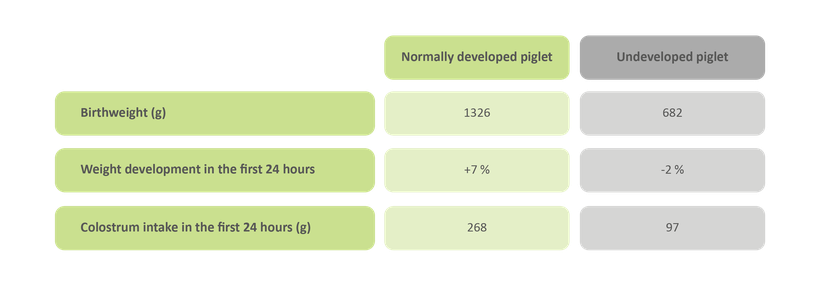 Figure 1: Underdeveloped piglets consume less colostrum in the first 24 hours of life compared to normally developed piglets, resulting in reduced weight development.
It All Starts With The Sow.
As production levels increase, appropriately managing and nourishing sows becomes more important. This ensures adequate piglet development during gestation and optimal sow health at parturition. A sow's health affects her ability to eat, produce colostrum and milk, and nourish her piglets, significantly impacting piglet survival.
Studies have shown that maintaining the proper body condition of sows and using targeted dietary formulations can work to improve piglet survival rates. Nutritional strategies can reduce the impact of stressors on the body. These strategies work by acting as antioxidants, antiinflammatories, osmolytes, tissue stabilizers, or essential cofactors in metabolism and tissue development.
Moreover, when administered in drinking water, they offer significant benefits. These strategies are tailored to each farm's unique situation and can include highly bioavailable trace minerals and vitamins for metabolic and growth support or probiotics and prebiotics for intestinal support. They can take the form of supplements or in-feed additives.
Colostrum and Milk Supply of Hyperprolific Sows – The Bottleneck of Productivity.
Although high-performance sows are producing larger litters than ever before, their biological capacity to support these piglets has not increased at the same pace. The intake of colostrum is crucial for the survival and development of newborn piglets, as it provides energy, ensures passive immunity, and promotes intestinal development. Yet, many piglets from large litters receive insufficient colostrum. Low-birth-weight piglets are particularly affected because they are often not vigorous enough to reach the udder in time. There is also high competition for teats, and the sows' colostrum production and quality are insufficient. These factors can lead to an inadequate supply of energy and immune support, which jeopardizes the survival of the piglets and impairs their later performance. For management, this means implementing targeted measures to ensure adequate colostrum intake, especially for weaker piglets.
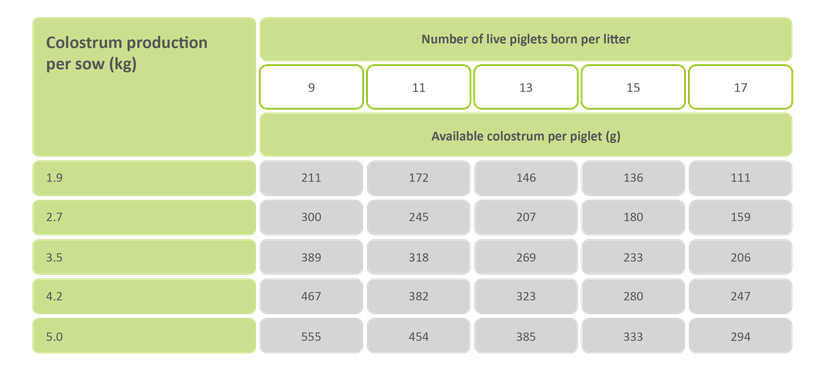 Figure 2: As litter size increases, the amount of colostrum available per piglet decreases. With an average colostrum production of around 3.7 kg, there is only enough colostrum for the first 11 to 13 piglets in a litter.
In addition to the issue of colostrum, it is important to consider the milk supply as a potential limiting factor. While modern sows have been shown to wean more piglets, there is often a mismatch between total milk yield and litter demand. The consequences of this imbalance can be significant, often resulting in higher pre-weaning mortality rates, uneven growth, and the need for increased management interventions. These interventions may include split suckling, cross-fostering, using milk replacers, or the use of nurse sows.
Moving forward, the sow and piglet should be addressed together as a single unit. Key to ensuring that every piglet gets a fair start is careful on-farm monitoring, fostering strategies, early supplemental feeding, and the use of in-feed additives. Hyperprolificacy has created new opportunities, but it has also exposed the physiological limits of the sow. The key to the future lies in aligning litter size with the sow’s ability to nourish her offspring, ensuring that they are viable and thrive.
The Hidden Burden: Stressors Impacting Modern Sows.
The physiological demands placed on today's hyperprolific sows are enormous. Large litters, prolonged lactation and a high metabolic rate put them under constant stress. Environmental and health pressures, such as oxidative stress, inflammation, and seasonal heat stress, can compromise fertility and affect milk and colostrum yield, as well as longevity and reproductive performance. Moreover, hyperprolific sows are increasingly prone to systemic inflammation, which can lead to disorders such as mastitis-metritis-agalactia (MMA).
Additionally, elevated inflammation impairs milk production, delays recovery, reduces piglet growth, and increases the need for treatment. Therefore, managing inflammation through nutrition, housing, and targeted health interventions is essential to supporting sow welfare, performance, and farm profitability. The future of sow productivity depends not only on genetics, but also on protecting sows from these invisible pressures.
Beyond Feed: The Power of Water Application.
Water is often the most underestimated resource in pig production. Strategic water application, whether through improved drinking systems, cooling sprays, or supplemental liquid feeding, can provide significant benefits. These methods can help reduce heat stress, stimulate feed intake, support milk yield in sows, and improve piglet growth and welfare.
Moreover, water enables the flexible and targeted administration of further nutrition or supplements. Stressed animals often decrease their feed intake, but their water intake usually remains steady or increases. Therefore, nutritional support can continue despite declining feed intake and supplements can be administered quickly without changing the feed. Better water management not only improves performance, but also enhances hygiene and reduces stress, making it a practical and cost-effective way to support productivity and animal well-being.
Early Support for Newborn Piglets: A Profit Driver.
The first hours of life are critical for piglets. Providing early support, such as ensuring colostrum intake, providing warmth, and administering treatments like supplemental energy, iron, or immune boosters, helps reduce mortality and improve vitality. Stronger piglets grow more uniformly, perform better throughout production, and ultimately increase farm profitability. Therefore, investing in early care is not just about survival; it's about setting the foundation for lifetime performance and economic return. Early support helps prevent diseases, reduce diarrhea, and lower the need for interventions, thereby decreasing mortality rates.
Nutritional Strategies and Farm-Individual Concept: The Key to Success.
Farms can optimize both animal health and performance by combining short-term nutritional supplements that target specific problems or preventive needs with long-term in-feed additive concepts. Tailored strategies adjusted to a farm’s unique challenges support growth, reproduction, and resilience, while addressing immediate issues such as stress, immunity gaps, and digestive disturbances. This integrated approach ensures interventions are effective and sustainable and aligned with long-term production goals.
There is no single solution, each farm requires a tailored approach. At Biochem, we understand that every farm is unique. That’s why we offer a broad portfolio of targeted products such as Stress Pack®Xtra, Fertility Pack®Sow, Piglet Protector®, Bimulac®Pre, and Ferroniq, which are designed for flexible, short-term application. When used alongside our long-term solutions, such as probiotics, prebiotics, mycotoxin binders, trace minerals and betaine, they help to create a farm-specific concept that supports both immediate needs and long-term goals
Optimizing animal health and performance requires more than a one-size-fits-all solution. By combining short-term nutritional supplements that address immediate challenges—like stress, immunity gaps, and digestive issues—with long-term in-feed additive strategies, farms can build a resilient, productive foundation for the future.
Are you ready to develop your individual farm concept? Get in touch with us today and let’s build your tailored strategy together!


